Rockwool vs Coco Coir for Automated Vegetable Seedlings: Yield, Consistency & Cost Views: 313
Choosing the optimal growing medium is one of the most critical decisions for modern vegetable producers using automated hydroponic and controlled-environment systems. Among substrates, rockwool and coco coir are two of the most widely used options — yet they differ significantly in their physical properties, performance characteristics, and operational implications.
This article explores how rockwool and coco coir compare as seedling substrates for tomatoes and other vegetables, with a focus on crop yield, uniformity, labor efficiency, and total cost of cultivation under automated seedling systems.
Why Growing Medium Matters in Automated Vegetable Seedling Systems
In automated hydroponic nurseries, the growing medium serves as the foundation for root development, water and nutrient delivery, and overall plant performance. For crops like tomatoes, peppers, cucumbers, and leafy greens, early-stage root health directly influences vegetative vigor, transplant success, and eventual yield performance in production houses or greenhouses.
A substrate that delivers predictable water retention, excellent aeration, and stable nutrient availability can dramatically improve operational outcomes — especially when integrated with automated irrigation, fertigation, and environmental controls.
Two substrates commonly used in commercial systems are:
· Rock Wool (also called mineral wool) — An inorganic, inert substrate made from natural basalt melted and fiberized at temperatures of up to 1500°C.
· Coco coir — a natural fiber medium derived from coconut husks
Each has advantages and challenges, and understanding these is essential for growers optimizing for yield, consistency, and total cost of production.
Physical Properties: Structure, Porosity, and Water Dynamics
Rockwool — Engineered for Uniformity
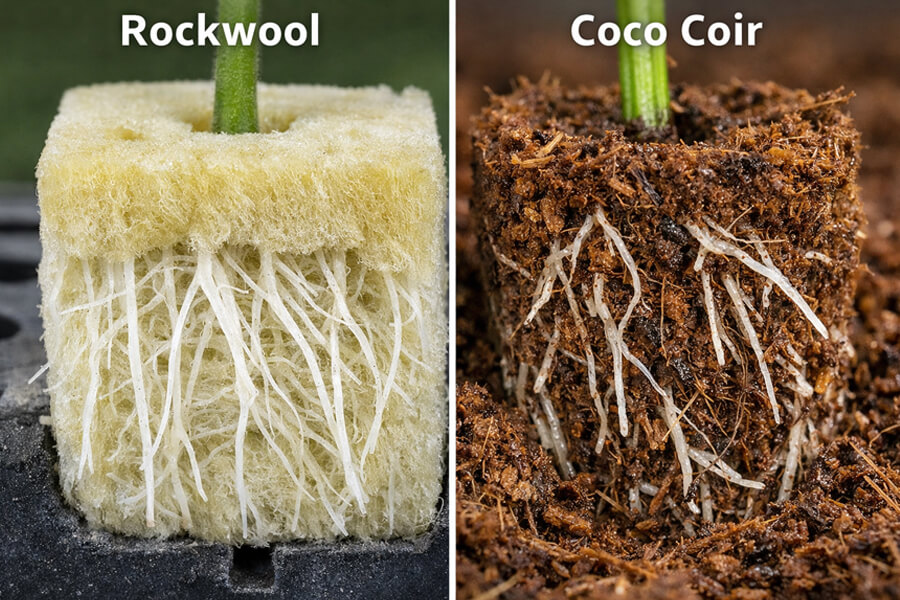
Rockwool is manufactured by melting basaltic rock and spinning it into fibres, resulting in a substrate with highly consistent texture and porosity. Its structure offers a combination of high water retention and excellent air content, which supports strong root respiration and robust seedling establishment.
Because rockwool’s internal voids are uniform, each cube or slab behaves predictably when integrated into automated systems. This consistency means irrigators can reliably set moisture targets and irrigation events — a major advantage in high-throughput nurseries where even small substrate variations can propagate into large differences in plant performance.
Coco Coir — Natural Fibre, Variable Structure
Coco coir is composed of coconut husk fibers, which inherently vary in size and composition. Its structure provides good water retention and moderate aeration, and it remains relatively stable over time.
However, because coco coir is organic, its water retention characteristics can be less uniform than rockwool’s, especially between batches. Variability in fiber size and residual organic components can lead to uneven moisture distribution, which requires growers to calibrate irrigation carefully in automated systems.
Root Zone Control: Water and Oxygen Balance
Healthy seedlings require a delicate balance of moisture and oxygen in the root zone. Substrates must retain water without becoming saturated and must provide sufficient air space to avoid root hypoxia.
Rockwool Provides Predictable Moisture & Aeration
Rockwool’s engineered structure promotes an ideal balance of water and air, enabling healthier, more vigorous root development in automated seedling systems. Because water is distributed uniformly, there are fewer dry or waterlogged zones — common issues observed with organic substrates.
This uniformity supports precise scheduling of fertigation events and enables moisture sensors — often integrated into automated systems — to deliver water and nutrients based on real-time data.
Coco Coir’s Water Dynamics
Coco coir holds water effectively but may trap moisture unevenly if the substrate is not pre-prepared correctly. Its natural fibers can form micro-clumps that resist even irrigation, leading some parts of the root zone to stay wetter than others.
While coco coir is generally forgiving in terms of keeping moisture available to roots, its variability makes tight moisture control more complex in automated systems where precision matters.
Nutrient Management and pH Stability
Rockwool: Inert and Predictable
One of rockwool’s primary advantages is its inert nature — it does not bind nutrients or influence solution chemistry. This neutrality gives growers full control over nutrient delivery, ensuring that every plant receives exactly the prescribed feed without substrate interference.
Rockwool also maintains stable electrical conductivity (EC) and pH conditions throughout the growing cycle, essential for consistent nutrient uptake in crops like tomatoes and cucumbers. Because nutrient availability can be accurately controlled, it enhances both uniformity and yield predictability.
Coco Coir: Natural Buffering and Nutrient Interaction
Coco coir has a high cation exchange capacity (CEC), meaning it naturally holds and releases certain nutrients. While this can be beneficial in some organic and semi-organic systems, it introduces variability in automated hydroponic environments where consistency is crucial.
Coco coir typically requires pre-washing and buffering treatments to remove salts and balance pH before use. If not done thoroughly, these initial variations can persist throughout the crop cycle, requiring additional adjustments during irrigation and nutrient scheduling.
Sanitation and Pathogen Management
In high-density nurseries, disease prevention is critical.
Rockwool’s Sterile Starting Point
Rockwool is produced at high temperatures and is essentially sterile when packaged. This means it begins every cycle free from microbes, pests, and weed seeds — a major advantage in seedling production environments.
Because it doesn’t break down over time, rockwool also minimizes habitat for pathogens that can accumulate in organic media.
Coco Coir’s Organic Nature
Although coco coir is naturally derived, it can carry residual plant proteins, fine dust, or even microorganisms if not thoroughly processed. This organic matter can contribute to microbial populations that require additional sanitation protocols in automated systems.
Although pre-treatment reduces these risks, it introduces labor costs and adds variation from batch to batch.
Yield Consistency in Automated Seedling Production
For vegetable growers operating automated nurseries, yield uniformity across trays and cycles is a core performance metric.
Rockwool’s Contribution to Uniformity
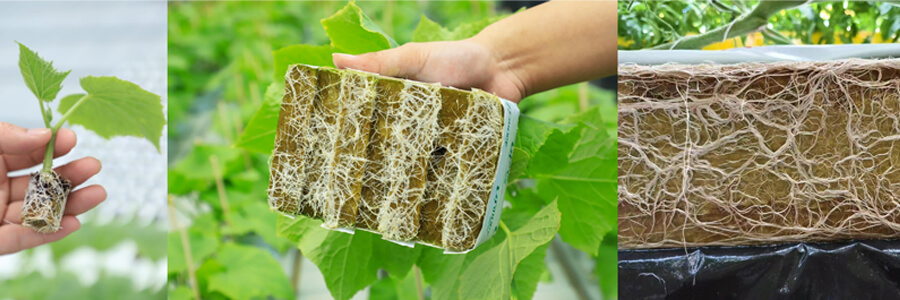
Because rockwool has consistent physical properties and predictable water and nutrient dynamics, seedlings propagated in rockwool often demonstrate tighter variation in size and development. This uniformity simplifies transplant scheduling and can improve overall production efficiency.
With rockwool, it is easier to replicate conditions from one cycle to the next — a major advantage for growers seeking consistent, high-quality transplants year-round.
Coco Coir’s Variability
Coco coir can perform well, but its natural variability means that achieving the same level of uniformity often requires more hands-on calibration and monitoring in automated systems.
In some environments, that variability can translate into uneven growth rates and wider variation in seedling size at transplant time.
Cost Analysis: TCO (Total Cost of Ownership)
Assessing substrate costs goes beyond purchase price. Growers need to consider labor, preparation, irrigation efficiency, and waste management.
Rockwool: Higher Upfront, Lower Operational Cost
Rockwool media often has a higher upfront cost compared to raw coco coir. However, its sterile preparation, lack of buffering or washing, and reduced variability can cut labor costs significantly in automated operations.
Because rockwool is compatible with full automation (moisture sensors, automated fertigation, data-driven irrigation), growers can reduce human intervention and improve resource efficiency.
Coco Coir: Lower Purchase Cost, Higher Prep & Handling
Coco coir typically costs less per unit of dry media. However, the need for pre-washing, buffering, and occasional substrate conditioning introduces labor costs and time delays that accumulate over multiple seedling cycles.
Moreover, because each batch of coco can behave slightly differently, growers often invest extra time tuning irrigation programs and nutrient schedules, which adds to operational costs.
Practical Considerations for Automated Systems
Compatibility with Automation
Rockwool’s uniform density and predictable behavior make it well-suited for integration with sensors, controllers, and automated irrigation strategies. Growers can set precise moisture targets and rely on rockwool to behave consistently from tray to tray.
Coco coir can be used effectively in automated systems, but its variable texture and water holding characteristics require more frequent system calibration and monitoring.
Conclusion: Choosing the Right Substrate for Vegetable Seedlings
Both rockwool and coco coir remain viable growing media in automated vegetable seedling production, but they serve different operational priorities.
Rockwool excels when the goal is:
· High yield consistency across large production volumes
· Tight control over water and nutrient delivery
· Integration with automation systems
· Predictable behavior cycle after cycle
Coco coir fits growers who want:
· A renewable and organic substrate
· Good moisture retention with biological activity
· Lower initial substrate cost
For producers focused on maximizing uniformity, minimizing labor, and fully leveraging automation for tomatoes and other vegetables, rockwool often delivers superior performance in terms of yield predictability and operational efficiency.
Selecting the right substrate ultimately depends on your production system, automation goals, and crop priorities — but understanding their differences equips you to make the best choice for your operation.






 Return