Rock wool is a mineral mixture in 1500~2000℃ high temperature furnace melting, centrifugal pressure sheet, cooling to 230℃ after adding resin, further cutting and processing. Rock wool belongs to the inert matrix, the chemical nature of its material is stable, the production process after high temperature treatment, sterile and non-toxic. UPuper® rockwool has light texture, high porosity (over 90%), strong water absorption, strong permeability, uniform space, good permeability and stable control of root EC and pH, and facilitate the growth of plant roots. UPuper® itself does not contain any nutritional elements, the growers can well regulate the water-gas ratio and various nutritional elements of the root environment. UPuper® rock wool is made of high temperature, to reduce the spread of diseases and insect pests from the source, compared with the traditional planting method, effectively reduce the cross-infection of bacteria.
Cucumber is a relatively important cultivated crop in northern China of facility production. In recent years, following the development and industrialization of China’s cucumber production, the quality, yield and disease resistance of cucumber are becoming more and more strict. At present, compared with the Dutch rock wool cultivation technology, there is still a certain gap in the facility rock wool cultivation in China. With stable product characteristics, combined with modern drip irrigation technology, UPuper® rock wool can better control the root environment of crops, accelerate the growth rate of crops, and improve the yield and quality of cucumber.
Disinfect the greenhouse before sowing
In the greenhouse on a crop pull seedlings, must remove clean crop disease residues. Before sowing, hydrogen peroxide solution or potassium permanganate solution were used to spray and disinfect the cultivation rack, seedling bed, ground and heating pipe in the shed. For 2-3 days before sowing, the whole shed was treated with chlorothalene and isoproba fumigant. Seedling cultivation was started after 2 days of disinfection.
Seedling
1.Soaking and germination
Before sowing, cucumber seeds need to be soaked in water for 8 hours, put in 25℃ for 12 hours to promote buds (seeds can be white), cover with wet gauze, spray water regularly, keep moist.
2.Sowing
All the round before sowing, the UPuper® rock wool plugs were soaked for 24 hours in nutrient solution with EC 1.0~1.2mS/cm and 5.5 pH. 5. Put the soaked rock wool plug into the 72 hole plate, cut a small seam in the middle above the rock wool plug, sow the white seeds in the seam, sow each rock wool block with 1 (or two), cover with vermiculite, and cover with transparent film moisturizing, wait until the cotyledon seedling film in time. The water was poured before emergence, and the EC value is 1.0~1.2mS/cm, pH is 5.5 to the cotyleddon, and the standard concentration of the nutrient solution was kept 1.0 cm deep at the bottom of the plate, and the water was supplied by the action of the bottom capillary. Cotyleons were sprayed twice a day after emergence.
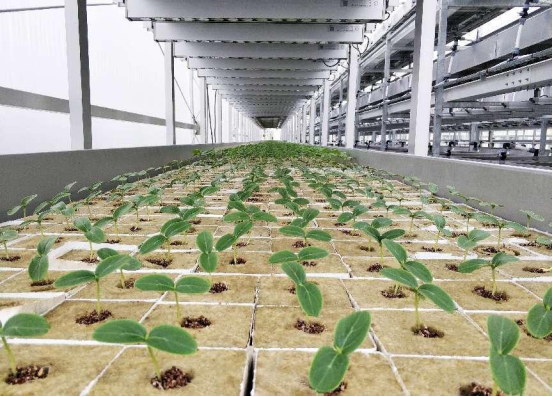
3.Transplant
14 days after the emergence (two leaves) transplanted to the UPuper® rock wool cubes, before transplantation, soak the rock wool cubes with nutrient solution with EC value 1.5~2.0mS/cm and pH 5.5 for 24h, put the rock wool plug with seedlings into the hole, irrigate the nutrient solution with EC value of 1.5~2.0mS/cm and pH value of 5.5~6.0, adjust the distance between the rock wool cubes reasonably, control the water content of the growing cubes guaranteed to be at about 80%, and the nutrient solution can be recycled and save cost. In order to ensure the consistent growth of cucumber seedlings, regularly observe the growth of seedlings and remove the weak seedlings in time.
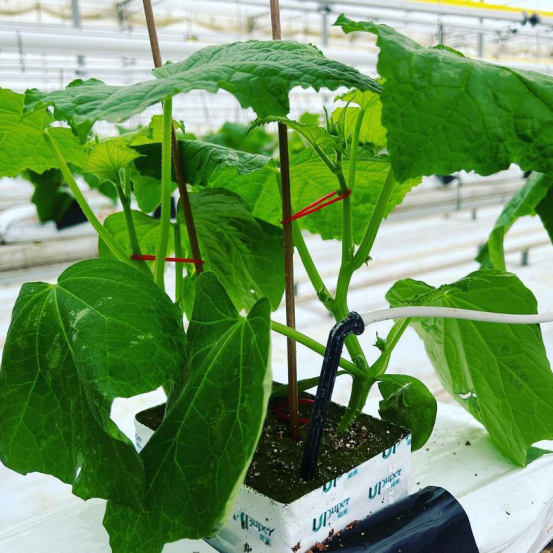
Cultivation on Slabs
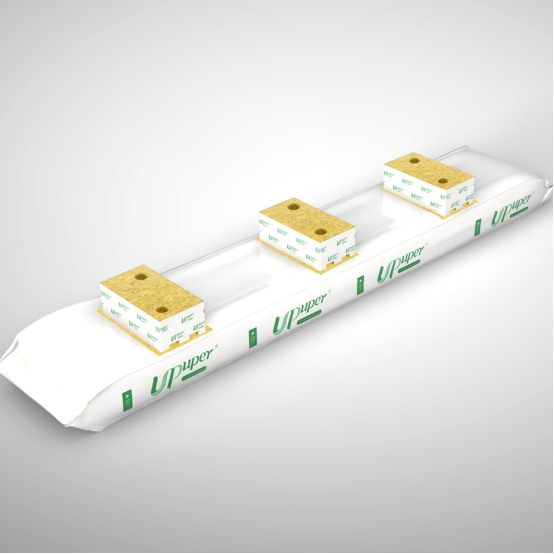
Before cultivate on slabs, three rock wool cubes should be placed according to the 1.2m rock tampon strip to open the rock wool slabs evenly. The rock tampons were completely soaked with the nutrient solution with EC = 2.5 mS / cm and pH = 5.5~6.0, leaving two drainage outlets at the bottom of the rock tampon to get out of the waste liquid. When the cucumber seedlings grow the seventh leaf, the rock wool cube is transplanted to the tampon strip colonization hole to avoid the root exposure to the air and air drying. Avoid shaking cucumber seedlings for one week after transplanting to affect root growth.
Greenhouse environmental control
1.Temperature
The optimum temperature required for cucumber growth is 25- -28℃. The daytime temperature in the greenhouse is controlled at about 25℃ and the night temperature at about 18℃. When the temperature is too high in sunny days, the skylight needs to be opened for ventilation and cooling, and the skylight should be opened slowly.
2.Light
Cucumber likes sufficient light, but also resistant weak light. When the light is insufficient, often cause plant fertility, cause the phenomenon of "melon". When the light is sufficient, the assimilation is strong, high yield and good quality. When the light is too strong, it can be covered by the sunshade net inside and outside the greenhouse; when the light is insufficient, the cucumber plant can be covered by the filling lamp. Rain and rainy days can supplement the light intensity, winter and spring to supplement the light time.
3.Humidity
Generally, the relative humidity in the greenhouse is controlled at 80% -85%, the relative humidity in the greenhouse should not be too high, nor too low humidity is easy to cause fungal diseases, especially too high humidity at night will make the production of water droplets in the greenhouse cucumber plants easy to infection diseases, leading to cucumber downy mildew disease. When the humidity is too high, the humidity can be reduced through the slow ventilation of the skylight. If the humidity is too low, the relative humidity of the air can be increased through the fog spraying device in the greenhouse.
4.CO2 fertilization
CO2 Fertilization is conducive to improving the growth rate and disease resistance of greenhouse cucumbers. CO2 Fertilization can also improve the fruit setting rate and commercial nature of cucumber, at the same time, can also make the growth period of cucumber ahead of time, yield increase, to achieve early harvest. The CO2 concentration in the greenhouse is 750- -850 μ L / L. It can be supplemented with a CO2 generator, and CO2 concentration can be adjusted with natural ventilation. The concentration of CO2 supplementation occurs during the day, when the plants can produce CO2 through respiration, so CO2 supplementation is not required.
Water and fertilizer management
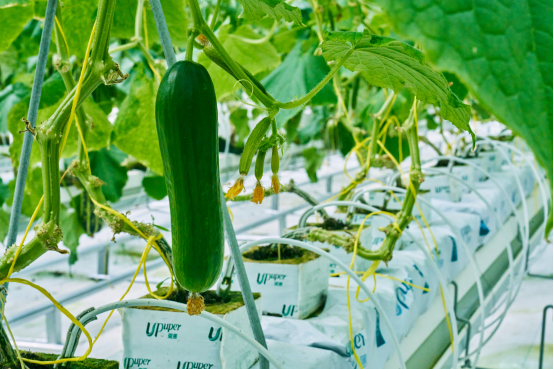
The regulation of nutrient solution is an important link of cucumber rock wool cultivation, and the nutrient solution in different growing period should be adjusted. As the plant continues to grow, the concentration of the nutrient solution needs to increase. The plant needs more fertilizer during the flowering and fruiting period, so the EC of the nutrient solution for irrigation should be adjusted to 2.5—3.0mS/cm. Nutrition solution irrigation is carried out in batches. When the rock wool matrix reaches saturation, it can be discharged from the lower drainage outlet. Rock wool matrix is generally alkaline, and the nutritional PH is controlled at 5.5- -6.0, which is conducive to plant growth and development.
Plant management
1.Hanging vines, falling
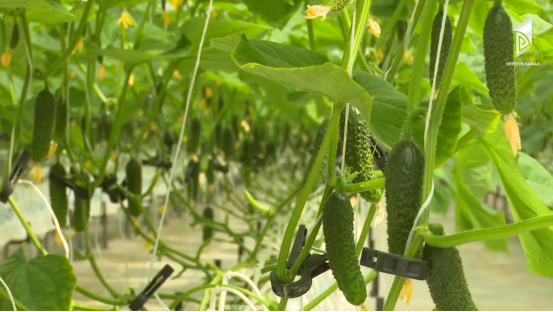
When the cucumber plant is colonized, it is necessary to deal with thin lines. One end of the thin line is fixed on the wire above the plant, and the other end is wound around the upper leaf of the lower end of the plant and fixed with a clip. Adjust timely according to the growth of cucumber plants. Plant vines can increase the ventilation and light transmission in the middle of the line, which is conducive to plant photosynthesis.
2. Fork, pick the heart
Cucumber generally adopts single stem pruning, the plant grows rapidly, need to remove the side branches regularly, the pruning every 4-5 days, remove the old leaves. When the plant grows to a certain height, the heart should be picked timely to make its lateral branch result.
3.Sparse flowers and fruits
After cucumber enters the flowering and fruit sitting period, it takes 5-7 days to have a sparse flowers and fruits. Eliminating excess flowers, deformed flowers, deformed fruits, etc., is conducive to reducing nutrient consumption and ensuring uniform and neat ears. Leave the fruit according to the plant growth rate. Plant growth can leave some more fruit, plant growth is weak to leave some less fruit, reduce the plant load, balance the plant vegetative growth and reproductive growth.
Extermination of disease and insect pest
Greenhouse rock wool cultivation diseases and insect pests should be based on prevention, greenhouse skylight installation insect control net, cultivation rack hanging yellow shading board. Seeds and greenhouse facilities were sterilized before sowing. Staff into the greenhouse to keep the clothes clean, the whole body disinfection, so as not to bring germs. And also combine pesticides when needed.White ground lice, aphids, tea yellow mites and other common pests of cucumber cultivation in greenhouse. Common diseases are powdery mildew, downy mildew, blight and so on. For these diseases, to choose the appropriate concentration of pesticides to spray, to spray in the evening, to ensure that the front and back of the leaves are sprayed.
Want to know more about UPuper® rock wool,please feel free to contact us.






 Return